Advertisement


Italy have just fallen agonisingly short of their best ever Six Nations campaign by losing to Wales in Cardiff. The Azzurri had never won three games in a single tournament before and letting this chance slip is a cruel end to what has been one of the best seasons in Italian international rugby history.
In this article we will take a deep dive into the numbers behind Italy’s Six Nations campaign. We will outline the reasons for their vastly improved performances, show where they still have room to improve, and ask the question: is the new Italy here to stay?
Before diving into the numbers, it is important to remember where Italy were just a few years ago. In 2021, they had their worst ever Six Nations campaign, losing every match by an average margin of 37 points. This was what led to pundits calling for them to be kicked out of the tournament in favour of Georgia. Safe to say, those calls have since gone very quiet.
To quantify the scale of Italy’s improvement, let’s compare their stats from this Six Nations to what they were two years ago. 2024 was current head coach Gonzalo Quesada’s first year at the helm and it also had the same home and away fixtures as this year, making it the most reliable comparison.
2024 was already a great Six Nations for Italy, with two wins and a draw, making it arguably their best tournament ever, but if we look into the stats, we see that 2026 was a clear step better. As a crude measure, the Six Nations websites lists 31 different metrics for measuring team performance. In 2024, Italy were ranked bottom in 14 of these metrics. After four rounds in 2026, they were ranked bottom in just six.
Meanwhile, the average margin, that was 37 points in 2021, had been cut down to just six. AKA, the margin has been reduced from over five scores five years ago to just under one score today - that is a phenomenal turnaround.
Unsurprisingly, the main reason for that margin reducing so dramatically is a vastly improved defence. Since 2021, Italy have knocked an average of 26 points per game off their points conceded. After four rounds in 2026, the average points conceded were 21.5, the lowest Italy have ever had in a Six Nations.
Some will point to the fact that one of the main rivals, Wales, have deteriorated significantly in that period, but that alone does not explain Italy’s significant improvements. For example, their historic first ever win against England was also their first win in the Six Nations against a side other than Wales or Scotland since 2013.
None other than double World Cup-winning Springbok coach Rassie Erasmus was full of praise for Italy’s defence, saying, “For me there’s a competitiveness about them, very in your face. They don’t apologise for having line speed. They believe in what they’re doing”.
A big reason for that defensive improvement is the physicality Italy are now able to bring to the game. Under Quesada, the Azzurri have ranked in the top three for dominant tackles for each of the last three seasons. According to Opta, Lorenzo Cannone has been their best defender, with 16 tackles per 80 and a tournament-topping 12 dominant hits, after four rounds. Meanwhile, Manuel Zuilani has continued his excellent URC form for Benetton, with six turnovers won.
That physicality has been replicated at the set piece, where the Italians have laid claim to having the best scrum in the Six Nations. Both Ireland and France found themselves undone in this department against Italy and whilst they still ended up beating them, the scrum was a major reason the scoreline was kept under control.
Mike Petretta from the Italian Rugby Forum highlighted the scrum as an area of strength for Italy before the tournament, telling the Six Nations Rewind podcast: “To be honest, that’s the thing I was most confident about. I think Ferrari has been very strong in URC. If you look back to last year, under Bortolami, Benetton had one of the strongest scrums.
‘Spagnolo, we know what he can do as an impact player, Nicotera is doing really well in the TOP 14, so I was probably least concerned about that. We also had three tests against the South Africans last year to measure where we were and by by the last game we were putting them under significant pressure.”
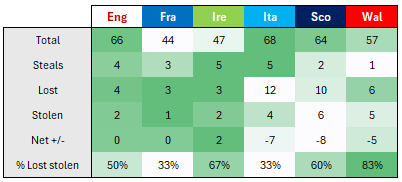
Elsewhere, Italy are also kicking the ball more than they were two years ago, showing they are much better at managing the territory battle. Perhaps more crucially, Italy are not only winning more line-outs than they used to, but also stealing more line-outs, which is a very effective way of stopping opposition attacks at source.
However, upon closer inspection, there is still some room for improvement at line-out time. Italy may have stolen the joint most line-outs, but four of their five steals came against Scotland in round one - who have the worst line-out in the competition.
Meanwhile, whilst they have the most line-out throws this championship, they also have the most losses with 12. Worryingly, of their 12 losses, only four were actually stolen by the opposition, meaning the other 8 were all execution errors on Italy’s part.
Earlier this year, former coach Franco Smith told Megafoon Rugby why the set piece pressure is so important to defence: “I told the boys back in the day that the opposition will stop kicking to touch when you start competing better. Once you start winning the scrum penalties, it won’t score you tries, but it will stop the opposition scoring tries.”
Despite Italy’s obvious improvements, there is still one department in which they are lagging behind the rest: the attack. Since the bonus points were introduced into the Six Nations in 2017, Italy have never registered a four-try bonus point. They may have brought their points conceded tally right down, but it is still higher than their points scored - meaning they should still lose most games they play.
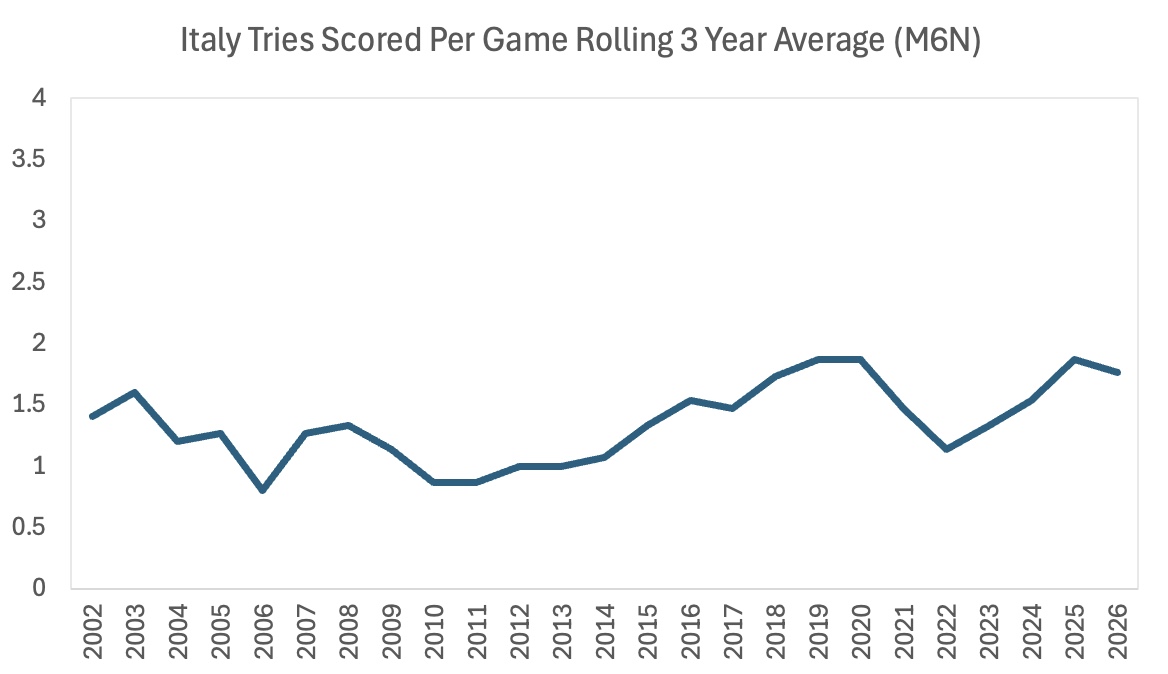
Even in 2026, after four games played, Italy ranked bottom for tries scored. This Six Nations has even seen a regression in terms of points scoring, as their average of 15.5 points per game is the lowest it has been since 2022, and they have averaged less than two tries scored per game every season since 2019. This is despite the fact that, in that time, try scoring in rugby as a whole has increased significantly. Italy actually scored more tries under Connor O’Shea than they currently do under Quesada.
If we look at some of the tries Italy have scored so far in this Six Nations, we see that both of their tries against England came from individual brilliance by Tommaso Menoncello, their only try against France came thanks to Thomas Ramos, trying to play from behind his own try line, and their only try against Ireland came from a driving maul.
This isn’t just a Six Nations problem, either: Since the 2024 November tests, Italy have scored more than 25 points in a game just twice - once against Chile and once against Namibia. Meanwhile, they have been held to fewer than 20 points in half of their games.
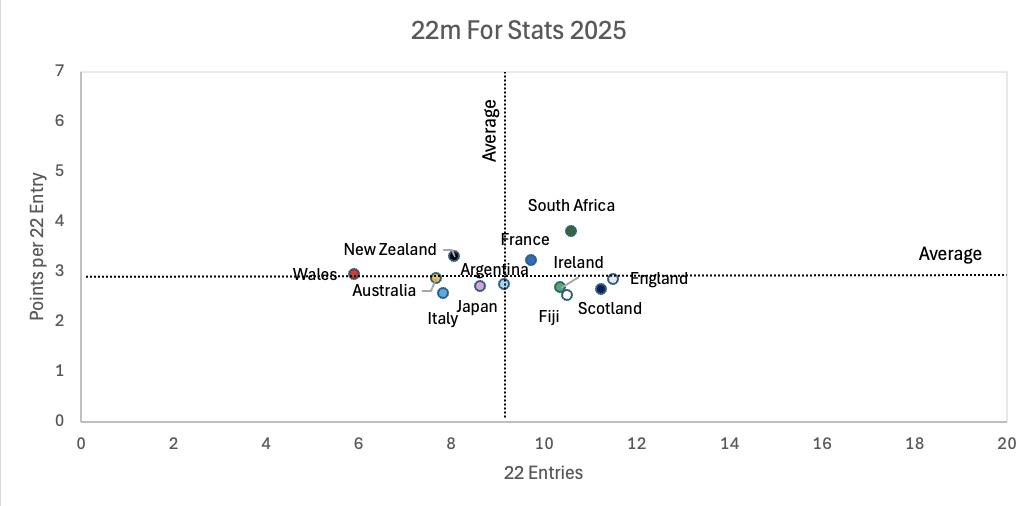
The below graph compares the average points per 22m entry for all tier-1 nations across 2025. We see that Italy lag behind their rivals for both 22 entries and for points scored when they get there. In the Six Nations this year, Italy averaged fewer than one point per entry against both Ireland and France. When the average points per entry is greater than two, less than one is a very poor return.
A symptom of this poor attack is their over-reliance on penalties. In the first four rounds of the Six Nations, Italy kicked 8 penalty goals. The next highest teams are Ireland and England, with five each, whilst table-toppers France kicked just one.
Franco Smith told Megafoon Rugby how improving the attack was key to Italy’s continued development: “You will have a better chance to create scoreboard pressure if you have the ability to score tries. Kicking in the space behind, moving the ball about, and good carriers. Getting more turnovers with that back row should allow them to get more attacking platforms and create scoreboard pressure.”
When a team’s try-scoring ability is so limited, we do, unfortunately, need to question the players who touch the ball the most: the halfbacks. Scrum-half has been openly acknowledged as a problem position for Italy over the last few seasons. Alessandro Fusco has mostly performed well for Italy in 2026, but few people see him as the long-term solution for that jersey.
“For me, hands down, I think Varney has the quality of pass that none of our other 9s have”, says Petretta. “Fusco has that physicality, but he only converted to 9 a few seasons ago. Same for Garbisi. For me, I think Varney is the most rounded and has worked on his physicality massively.”
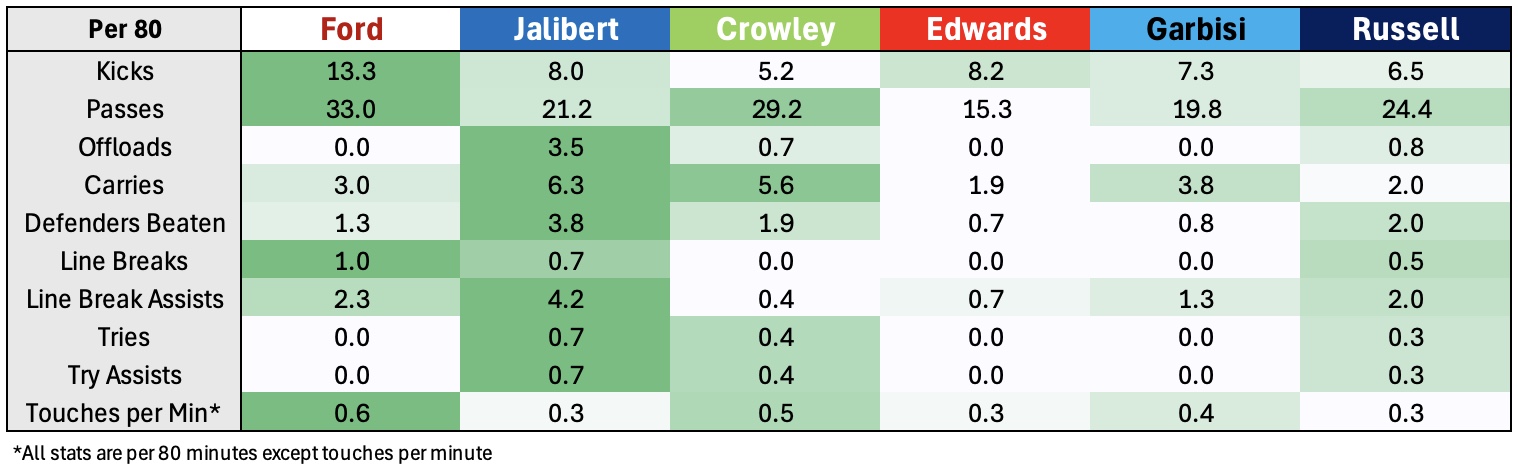
Then there is fly-half Paolo Garbisi. Garbisi burst onto the international stage at a young age, but despite receiving praise from some pundits, the numbers suggest his recent form has been poor. After the first four rounds, he has played every minute of every game but has not registered a single try involvement - the only player to hold that unfortunate statistic. The below table shows how Garbisi is lagging behind several rivals in key attacking metrics.
Things aren’t going much better for him at club level, either. His current team, Toulon, replaced Garbisi mid-season with Argentinian fly-half Tomas Albornoz. Rumours are that he will be released by the TOP 14 side at the end of the current season and is currently seeking new employ.
However, his former coach, Franco Smith, continues to back him: “Paolo played 10 games for me when I was with Italy. By then, he hadn’t played five games for Benetton! I’m really proud to see him getting over 50 caps”.
Petretta agrees that Garbisi is the right man: “In Italy he has a lot more freedom to play as he wants to play. That’s why I was getting excited about rumours he was coming back to Benetton. He has moments of brilliance - he just needs more game-time and to be given the keys to the castle”.
There is also a question over who should be Italy’s fullback, with the jersey having been passed around somewhat in recent seasons. Many think it should be Ange Capuozzo, but his club side Toulouse have firmly shifted him out to the wing, where he has absolutely flourished.
With a second successful Six Nations in three years in the bag, the question now becomes whether or not Italy can sustain this level of performance. Contrary to what people may think, Italy have shown signs of progress before, only for that progress to be lost in dramatic fashion.
In 2013, they beat both France and Ireland in the same tournament and had a defence that was roughly as good as it has been in 2026. However, they then went on a run of just one win in 8 seasons, declining year on year until their ultimate low point in 2021.
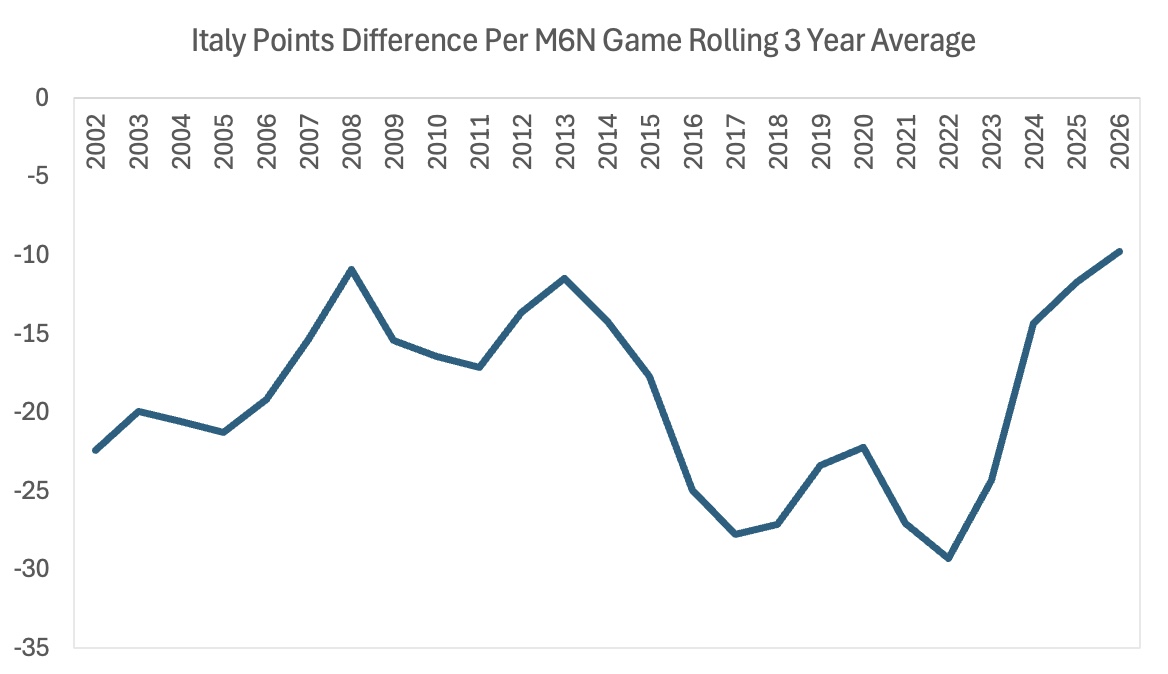
Even since then, there have been false dawns. The Italians showed glimpses of progress under Kieran Crowley in 2022 and 2023, only to be humiliated by 90 points against the All Blacks at the World Cup later that year, amidst rumours of dressing room unrest.
Thankfully, there are signs that this time around the progress can be sustained. Italy’s U20s have maintained a level of competitiveness for several seasons and there is now an Italian A side above it to further the players’ development. Meanwhile, the URC teams, Benetton and Zebre, are considerably stronger than they were 10 years ago.
“With Zebre, they are the one with the closest links to the national team; Quesada has the most influence there over how they play and who gets game-time”, says Petretta. “We’re starting to see less focus on results and more focus on performance at player level. I think that’s contributing [to Italy] more than the club’s results.
“I’m always optimistic about Zebre getting better. I think the coaches are excellent. Benetton need to find a coach. We need to find someone who is going to provide identity. Honestly, I’m more concerned about Benetton than I am about Zebre. There’s a lot of issues about how we are developing players, about quotas for international players, etc. I would love to see them invest a lot more money in coaching and a lot less in players, if I’m being candid.”
“The big thing is you need the club coaches to make sure the players are developing”, agrees Smith. “It is important there is a good understanding what the philosophy is between the clubs and and national team […] It’s really tough to coach basic structural components in a test match week […] That sits mostly with the club coaches.”
It seems someone at Benetton was listening. In recent weeks, they have announced the appointment of former Six Nations-winning Wales coach, Wayne Pivac. Pivac’s pedigree at club level is unquestioned, having taken the Scarlets to Pro12 glory in 2017, in the process building the core of the team that took Wales to a Grand Slam and World Cup semi-final in 2019.
If Pivac can rebuild Benetton’s squad to compete for the URC play-offs, and Zebre can continue to give opportunities to young talent, the foundations of Italy’s success will be much more stable and have a better chance at longevity.
Certainly, their former coach is bullish about their future: “When I was there, it was a completely different situation to what Quesada has now […] The players were not physically developed”, says Smith. “In 2021, I had to use 14 or 15 players under 21. I predict that Italy will have the most capped players at the 2031 World Cup and most of them will have played in 3 World Cups.”