Advertisement

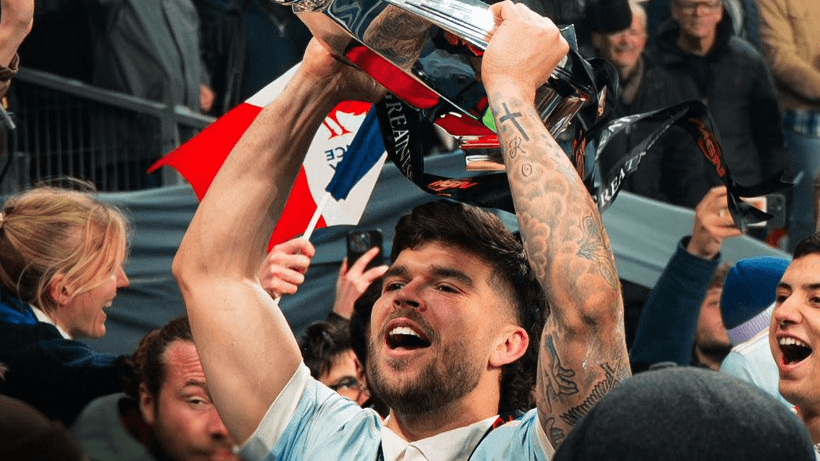
The 2026 Six Nations was a tournament full of contrasts and paradoxes. Fitting then, that by winning a second successive Championship title, France were both fully deserving winners and incredibly lucky to scrape through to victory.
If you’re reading this article, you probably don’t need to be told that Thomas Ramos nailed a long-range penalty with the last kick of the tournament, after a fortunate awarding of a penalty in the final play. There was something inevitable about those final minutes in Paris, not just that Ramos would nail the kick at goal, but also that he would inevitably be given the chance to have that shot at victory. Despite this feeling of apparent certainty, it’s hard to escape the fact that France got away with one. For the second week in a row, they had conceded 40 points and, for the most part, had been outperformed, if not entirely outgunned.
Last year, France’s winning Six Nations campaign was as good a Six Nations title victory as you can get without winning a Grand Slam. Not a perfect campaign, but not far off. In 2026, France were deserved winners of the tournament again, having topped nearly every single leading metric used in the modern game. However, this year’s campaign was clearly an imperfect one for France.
The scrum struggled throughout, and is a serious concern going forward. France will certainly not win a World Cup with the scrum at its current level, and without significant improvement in that area , they will struggle to win the Grand Slams that many think they are capable of.
Shipping upwards of 40 points in the final two games will also be a concern for France, even if defence coach Shaun Edwards was happy to attribute some of that to evolution in the wider global game. France looked good defensively with the Bordeaux duo of Nicolas Depoortère and Yoram Moefana in the centres, but any defensive solidity seemed to disappear with Depoortère when he left the field with injury against Scotland. The pairing of Moefana with Pierre-Louis Barassi does not seem to work defensively.
What may have helped France defensively in those last two games would have been the presence of a jackal threat. In the run up to the 2023 Rugby World Cup, the likes of Jonathan Danty, Gaël Fickou, Gabin Villière and Greg Alldritt meant that France had jackal threats across the field. For now at least, these players are out of the picture for France, and they only have limited breakdown threats compared to other teams in the Six Nations. Having an extra turnover threat somewhere in their side - to assist the valiant efforts of the likes of Julien Marchand, Péato Mauvaka and Yoram Moefana - would help France. It would also potentially give them more turnover ball - and we know just how deadly they can be with that…
And France really were excellent on counter attack in this tournament. With Mathieu Jalibert in the side, France have more attacking weapons and have more variation in how they can punish other teams. His integration into the side and the development of the three-way playmaking axis with Antoine Dupont and Thomas Ramos is one of the undoubted positives from this Six Nations for Les Bleus.
The fluidity of the playmaking responsibilities was typical of the fluidity throughout France’s squad over the course of the tournament. One of the most interesting developments of this tournament was how head coach Fabien Galthié tweaked the back five of his pack, adjusting selection and responsibilities based on the opposition. He may have given himself some selection headaches going forward, but he’s also unleashed a wealth of possibilities and built some significant squad depth.
This was clearly a successful Six Nations for France. There is a lot of love and public goodwill for the national side in France, but with that comes a heap of expectation on Fabien Galthié and his coaching team. The issue of how many (or how few) Grand Slams have been won since he took over in 2020 is one that is not going away for Galthié. On the whole, it feels like this tournament was a 7 out of 10 or a B+ for France: it was good, but still plenty of room for improvement.
Look out for another article on All Things Rugby running through the individual player ratings for the tournament.