Advertisement

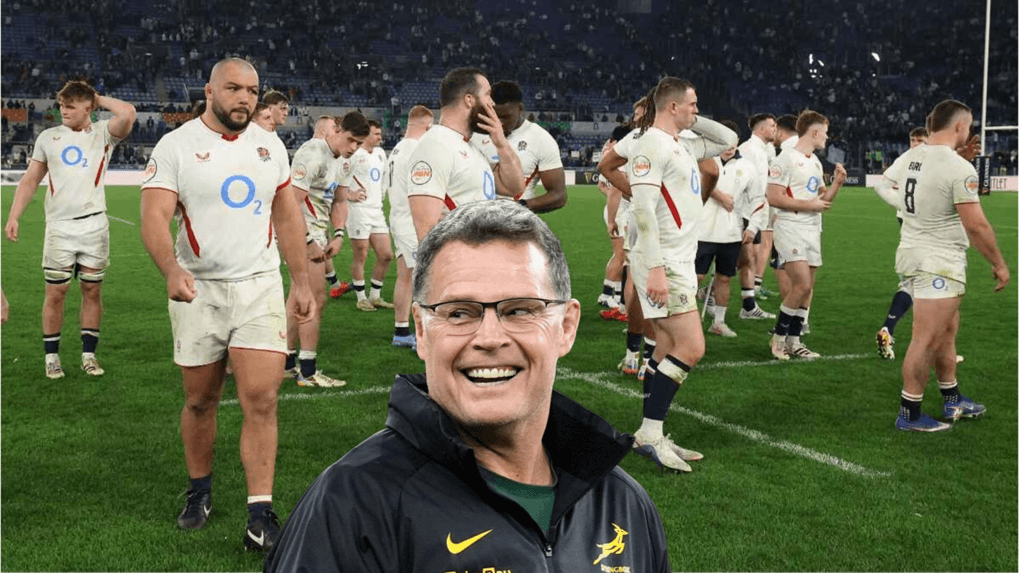
Ahead of England’s historic first ever loss to Italy in the Six Nations, South Africa’s World Cup winning coach Rassie Erasmus was asked for his thoughts on their current struggles. Steve Borthwick’s men had just slumped from 12 wins in a row to thrashings at the hands of Scotland and Ireland. People wanted to know what had gone wrong.
In response, Erasmus questioned how good England really were during their winning streak: “When teams build up good records you must look carefully at who they beat… The All Blacks weren’t at their best, we all know that… what other big teams did they beat?” The Springbok coach added “I was thinking are these guys really on a good run? You might see some cracks in there…”
Did Erasmus really see England’s collapse coming? Was England’s 12 match winning run always built on sand? To find out, let’s take his advice and examine each of those wins one by one, considering not only who they were against but what happened in those games. Then, at the end of the article, we’ll discuss another of Erasmus’ predictions that could spell the end for Steve Borthwick as England coach.
Coming into 2025, Steve Borthwick was a man under pressure. Despite a strong showing at the 2023 World Cup, he already had several unwanted records to his name such as a first ever loss to Fiji and a heaviest ever England home loss – a 53-10 thrashing at the hands of France.
2024 had seen his gameplan and selections come in for heavy scrutiny and after losing the Six Nations opener against Ireland, England had just 2 wins from their last 9 games – both of which came against lowly ranked Japan.
People disliked Borthwick’s data driven, kick heavy tactics which were an anathema to the free scoring rugby they were watching at club level in the English Premiership. What’s more, the players themselves had spoken openly about wanting to play a more entertaining style of rugby.
The press, and the public, were demanding change. In response, Borthwick dropped fly-half Marcus Smith in favour of Northampton 10 Fin Smith for the home match against France in round 2. Marcus was instead shifted back to fullback. To date, he has not started an international game at fly-half since.
After a thrilling match where France bombed multiple guilt-edge try scoring opportunities, England scored a try in the last minute of the game, with Fin Smith nailing the conversion to give his side a narrow 1-point victory. The pressure eased, but was not completely gone.
Fin Smith was retained in the team for the Calcutta Cup match against Scotland 2 weeks later. The match itself was a drab affair where England’s kick heavy strategy once again came in for criticism, to the point where the players on the pitch were by the England fans.
Scotland outscored England 3 tries to 1 in this game but, crucially, Scotland fly-half Fin Russell missed all 3 conversion attempts, including one right at the last moment, to gift England another 1-point win. With 2 wins on the bounce, the pressure subsided further.
A third successive home game and a third successive win. This was the first game where we saw Fraser Dingwall brought in at 12, where he would be retained for 8 of the next 11 games as Borthwick finally started to build his backline around the Northampton core that was performing so strongly at club level.
Italy, though much improved, where having a patchy Six Nations and had never beaten England at Twickenham. A few weeks earlier, they had taken 70 points off France and England cut loose in similar fashion, running in 7 tries in their biggest Six Nations win under Borthwick so far.
That Italy win was followed up in similar fashion by an excellent performance in Cardiff. 68-14 was the biggest defeat England had ever inflicted on Wales and for the Welsh it marked perhaps their lowest ever ebb. Tom Roebuck was installed on the left wing, a position he would hold for 9 of the next 12 games, whilst Freeman joined clubmate Dingwall in the midfield.
However, it is important to consider where Welsh rugby was at that time. The sport of rugby in Wales was in chaos and the humiliation at the hands of England was blamed on the wider context of terrible mismanagement by the WRU. Still, England marched on.
One game that is always brushed over in England’s 12 match winning streak is the game against France at Twickenham in June 2025. It was not classed as a full international match, but the two sides that took to the field that day included the likes of Jamie George, George Ford, Gael Fickou and Theo Attissogbe. These were essentially the sides that went on to play the fully capped international tests in the July tours.
During the Game, England enjoyed a 2 score lead right up until the 74th minute, when quick-fire tries from France’s Mallez and Taofifenua allowed France to steal the victory from right under English noses. The loss was quickly brushed under the carpet. Never mind that these were 2 strong teams, coached by full international coaches - it wasn’t an official international, so it wasn’t counted.
England headed to Argentina for their July series tests. Los Pumas had just created history by beating the British & Irish Lions in Dublin but coach Felipe Contepomi had elected to rest several of his front line players in favour of blooding new talent.
Borthwick’s team was also much changed, having lost most of his best players to the Lions tour that was happening in Australia. Freddie Steward returned to the line-up at fullback, a spot he would retain for 8 of the next 9 tests. He was also forced to call in a new attack coach in Lee Blackett as Richard Wigglesworth was another taken from him by Andy Farrell’s Lions.
A bizarre game ensued. In the first half, Argentina were well on top and with England picking up 2 yellow cards. However, they failed to make their 2-man advantage count as white-line fever gripped their forwards. A George Ford drop goal gave England an unlikely 3-0 lead at half time.
Upon the resumption, England blitzed Argentina, scoring 3 tries in just 8 minutes. The hosts were completely shell shocked as Ford guided England to a comprehensive 35-12. After the game, everyone appeared genuinely shocked at the margin of victory and Ford received huge plaudits for his performance. The fly-half, like Steward at fullback, would be retained by Borthwick for 8 of the next 9 games.
The rematch a week later was a much tighter affair with the scores locked at 17 all right up until the 78th minute when a Jack van Poortvliet dived over to snatch the win. Against all odds, England had exceeded expectations and delivered back to back wins away in Argentina with a team devoid of its top stars. The media, and the fans, were deeply impressed.
England headed north for a match against tier 2 nation the USA. The Eagles had been struggling badly in recent times, losing to Spain a week earlier, and would go on to lose to Canada in the game after this. The match was disrupted by lightning storms, but ended up as a predictably comfortable win for the English, 40-5 the final score.
The Argentina tour clearly had a huge impact on Steve Borthwick’s plans. Lee Blackett, who had only joined the coaching staff on secondment from Bath, was appointed on a permanent basis, with the RFU paying the club compensation to secure his early release from his contract. Wigglesworth, having returned from the Lions Tour to see his job given to someone else, was shunted to defence with current defence coach Joe El-Abt demoted to forwards coach.
Despite Fin Smith having been key to England’s turnaround in the Six Nations, he too lost his place in favour of Ford thanks to the latter’s performances in Argentina. Other Lions also lost their places, with Borthwick opting to mainly stick with the forward pack that had performed on the Argentina tour, meaning the likes of Ellis Genge and Will Stuart were force to take a place on the bench. With Tom Willis moving to UBB in the TOP 14, Ben Earl was restored to number 8.
In the first game of the November series, the rejigged England side faced an Australian team that was in disarray. The Wallabies were dispatched comfortably, a 25-7 scoreline belying how dominant England were on the day. They would go on to lose every single match they played on their end of year tour.
Fiji arrived at Twickenham a week later for their first game of November. Despite being theoretically a weaker opposition, the gave England a serious test, and could have been within a point of their hosts going into the final quarter were it not for a Kurivoli knock on with the try line at his mercy. A yellow card to Josua Tuisova soon after, along with a breakaway try from Henry Arundell, allowed England to embellish the scoreboard – 38-18 was how it finished.
Arguably England’s best win under Borthwick. New Zealand had been in patchy form for all of 2025 and had recently suffered their worst ever defeat at the hands of the Springboks in Wellington. However, any win against the All Blacks is a famous one and despite trailing at half time, England ran out winners with a 33-19 scoreline thanks to a dominant second half.
Borthwick’s kick-heavy gameplan and the so-called ‘Pom Squad’ bench functioned at the best they ever had, with the Kiwis completely unable to offer any kind of answers to the questions England were asking of them. The result would go on to play a large part in Scott Robertson being the first ever All Blacks coach to be sacked between World Cups.
For a third time in 7 games, England faced Los Pumas. Once again, Argentina squandered multiple try-scoring opportunities as England built a 17-3 lead at half time. However, in the 2nd half, we saw the first signs of Borthiwick tactics starting to come undone. In a full-strength Argentina, England were for the first time facing a team who could compete with them in the air, meaning the kicking dominance they were able to assert over the All Blacks was not repeated.
Gradually, the visitors clawed their way back into the game. They scored 20 points in the second period and looked like they might snatch the game with the clock in the red and England having a man in the bin. However, a final lineout malfunctioned and England survived – just.
A full 12 months on from England’s last test defeat they face Wales once again in the Six Nations. Welsh Rugby was in no better state than it was the last time the two sides met and the men in red delivered one of the all-time worst performances in Six Nations history, giving England an easy 48-7 win. After the match, George Ford admitted England hadn’t played well, despite the margin of victory.
It is difficult to argue that any test level winning run that lasts 12 matches is built on luck, clearly England deserve credit for what they achieved in 2025. The standout wins were at home to the All Blacks and the Argentina tour in July, although as Erasmus pointed out neither foe was at their strongest in those games.
The 2 wins against Wales and the victories over Italy, USA and Fiji were all expected due to none of those teams being realistic threats to England at that time. The win against Australia should be considered in a similar context; they were a team in disarray whose 2025 got worse as it went on. The wins against France and Scotland both Involved huge slices of luck; England had no influence on Finn Russell missing all 3 of his conversion attempts and the French blew multiple big opportunities before allowing England a last-minute score to steal the victory by a point.
You could argue that at least one of the wins over Argentina came in similar fashion, although not quite as extreme cases. The fact that most of those games were played at home was also a factor, especially the ones that finished within a score. Analyses have shown the ‘Twickenham factor’ to be worth on average 12 extra points to England compared to away games.
Can we therefore conclude Rassie Erasmus was right to cast doubt on the legitimacy of England’s winning run? He was certainly correct to say there were cracks in the performances; England’s wins tended to be narrow unless there was a significant mismatch in terms of overall quality. The winning run started with 2 games that were lucky wins and their best win was mitigated by the fact the opposition went on to fire their coach soon after amidst rumours of dressing room unrest.
On the other hand, the only top 10 teams that England didn’t beat during the winning run were Ireland and South Africa. They lost to Ireland immediately before the win streak began but they never had the opportunity to play the Springboks whilst the streak was ongoing. Hence, it is unfair for Erasmus to suggest England didn’t beat many big teams; they beat all 3 Rugby Championship teams they faced and 4 out of 5 Six Nations teams. The fact they did not get the chance to play the number 1 team in the world isn’t England’s fault and their record against the rest was statistically the best out of any nation in 2025.
The most foreboding thing that Erasmus said, however, was not to do with England’s winning run but instead related to their recent defeats. Ahead of the Italy game, he made a prediction which suggests, with hindsight, that the end has already come for Steve Borthwich as England coach.
He said “the question will now be can they turn it around? Is the structure good enough to handle these losses? Is their defensive pattern good enough to handle these losses? Are you this close to being fired or are the players really tight? They will either show it or not show it on Saturday.”
We now know that England went on to lose that game. They did not ‘show it’ on Saturday. In the process, Borthwick reversed many of the decisions he had made during the winning run. For instance, Steward, Dingwall and Ford were all dropped from the 23 entirely. This suggests that England’s structures are not strong enough and that the players are not tight. Therefore, according to Erasmus’ logic, Borthwick is indeed ‘this close’ to being fired.