Advertisement


Last season the Scarlets were Wales’s best team; The West Walians flew the flag for a beleaguered rugby nation, winning 9 URC games including famous victories at home to eventual finalists the Bulls and Leinster. They qualified for the Champions Cup and made the league knockouts. In the process, they played genuinely interesting rugby that was fascinating to analyse.
This season, however, all that positivity has been lost. The Scarlets currently languish at the bottom of the URC after 8 games and have just gifted bonus point wins to two of their most bitter Welsh rivals. In this article we will look to the data to understand what has gone wrong for the men in red and the underlying trends that are making fans even more concerned.
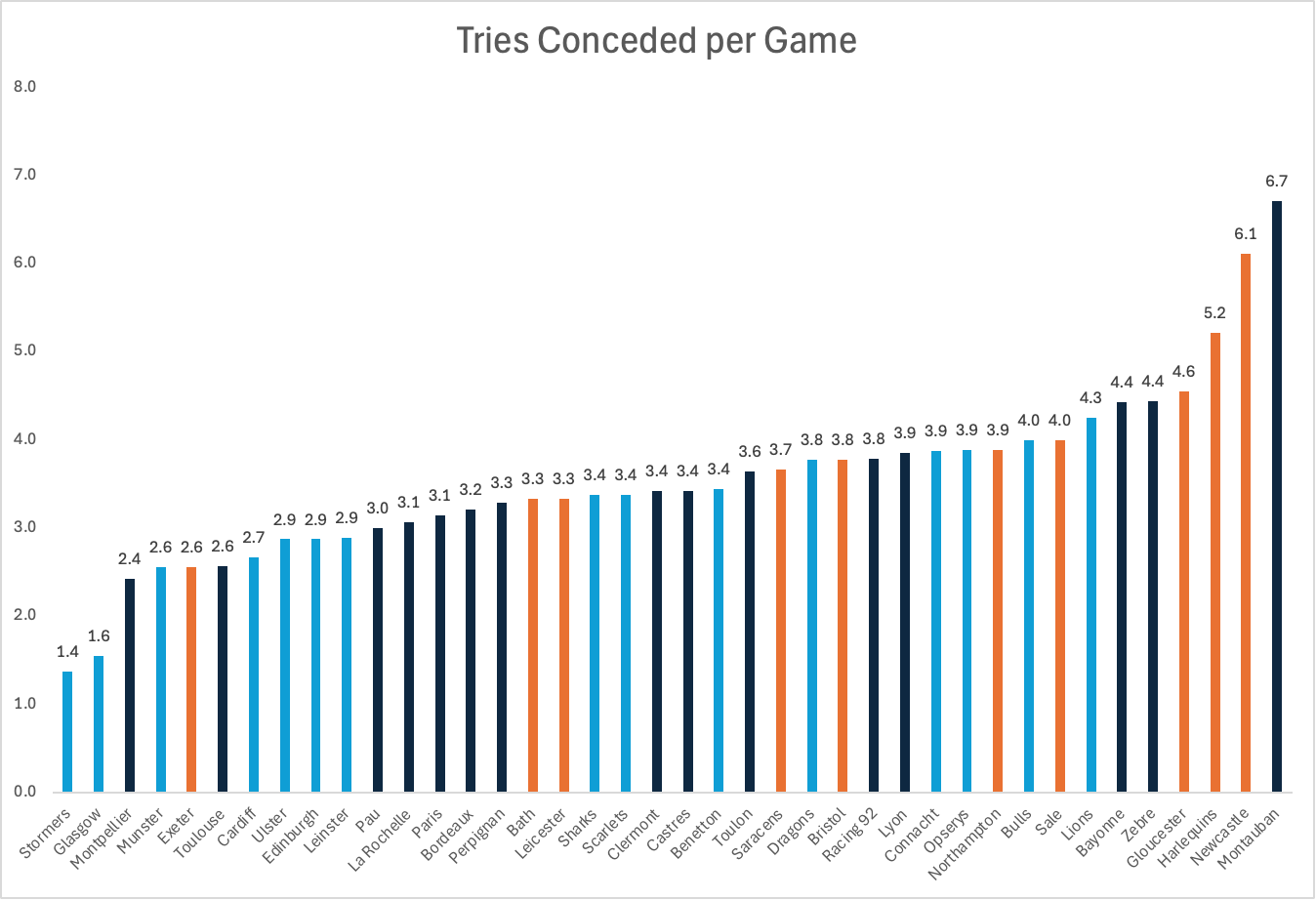
Surprisingly for a team at the bottom of the league, the Scarlets defence isn’t too bad. Yes, they have just given up 4 tries in their last 2 games, but in club rugby teams conceding 4 tries isn’t a rare occurrence. There are 8 teams in the URC who have conceded more points this season than the Scarlets whilst 9 of the 14 teams in France have a worse points conceded per game record and a whopping 8 out of 10 English clubs let in more points per game.
According to Opta, they are in the top half of the URC for gainline denial and for missed tackles being recovered. They do not tend to make many dominant tackles, but that is partially down to how vital jackalling is to their defensive strategy. The Scarlets allow their opponents to go through the fewest rucks between jackals of any team in club rugby – a tactic lead by openside and captain Josh Macleod and Springbok hooker Marnus van der Merwe.
Last season, the Scarlets’ set piece was one of the most reliable in the world with excellent scrum and lineout success whilst they were superb at stealing opposition throws. This season those numbers aren’t hitting the same levels but they are not disastrous, ranking in and around mid-table for most metrics.
Where the Scarlets consistently rank bottom of the stats, however, is in the discipline stakes. Last season they were the most penalised team in the URC, this season they are the 2nd most penalised (having played a game fewer than most rivals) and have received 9 yellow cards and one red card in 8 games. The question is: is the poor discipline a disease in and of itself or is it merely a symptom of another disease – such as frustration or poor organisation?
This is where the Scarlets truly are struggling this season. Before we get into the headline figures of tries scored and offload success, first we must consider the shape of the Scarlets’ play.
Ask any Welsh rugby fan to define ‘the Scarlets way’ of playing rugby and they will answer with exciting backs moves, side-stepping, counter attacks, playing of turnovers, targeting the space, slick handling and spreading the ball wide. Last season, whilst it was far from champagne rugby, the Scarlets did score several very exciting first phase tries that include intricate backs play.
This season, those types of tries have totally disappeared. In terms of wide play, fans will be horrified to learn that the Scarlets are the 2nd least likely team in the URC to shift the ball wider than 10 metres from the last ruck. Meanwhile, they have just 47% of their rucks under 3 seconds, the lowest of any club side in the world.
Opting for this slow, tight play with a forward pack not known for its strong ball carrying is a baffling tactical decision and the stats expose that: The Scarlets have the worst gainline success of any club team in the world at 51% whilst they are the 2nd most likely team in the league to be double tackled – showing how predictable their attack is.
It gets worse: The Scarlets need a huge amount of possession to cross the try line – a joint league high 19.4 possessions per try – but 46% of their possessions end with them kicking the ball away, the highest in the URC. Compounding this issue, just 11% of the Scarlets’ kicks are contested. This means that a significant proportion of the Scarlets’ attacks end with them simply gifting the ball to the opposition.
Finally, even when the Scarlets manage to earn an attacking set piece within 10 metres of the opposition line, they only convert 29% of them into tries scored – the worst return of any URC side. These stats culminate in the Llanelli based region scoring the fewest tries in the league this year and being the only team in the URC or PREM not to have recorded a 4 try bonus point this season.
Aside from tactics, what are the underlying causes of the Scarlets’ troubles? Regular watchers at Parc Y Scarlets will recognise a number of long running issues Dwayne Peel’s side has had since he took over in 2021. The first is the aforementioned discipline, the second is leadership. When squad captain Josh MacLeod is out of the side, the armband has been passed around between hooker Ryan Elias, scrum-half Gareth Davies and centre Johnny Williams.
The over-reliance on star fly-half Sam Costelow is also a major issue. It is widely acknowledged by those both inside and outside the Scarlets that they are barely functional as a team without their first choice number 10. Costelow is like a light-switch for the team; the attack has shape and organisation when he plays a none when he doesn’t.
Unfortunately, Costelow has been injury prone. This means that a significant amount of game time has been going to his deputies. For the 2 seasons prior to this, that was Ioan Lloyd (now at Cardiff) and this season it is Joe Hawkins. What these two players have in common is that they spent almost their entire careers before joining the Scarlets playing in positions other than 10. Lloyd spent most of his time at Bristol as a back 3 player whilst Hawkins was – and still is – primarily a centre.
Why the Scarlets have twice opted to gamble on project players in their most important jersey is extremely perplexing, with possible pressure from team Wales to accommodate bringing both players back from England the only acceptable answer. Watching them struggle to learn how to play 10 on the job has many Scarlets fans demanding the selection of 18-year-old Carwyn Leggatt-Jones – who was playing for his college side just last month.
Foremost in Scarlets’ fans minds is the position of head coach Dwayne Peel, subject as he was to ‘sacked in the morning’ chants in the last game. Peel is in his 5th season in charge and has a 37.5% league win rate. A Scarlets legend (having represented the British & Irish Lions and won the Celtic League as player for the club) Peel cut his teeth as an attack coach for Ulster before being rapidly promoted to the top job at the Scarlets – some argue too rapidly. Given he is supposedly an attack first coach, the stats revealed in this article are particularly damning.
The hand Peel has been dealt is a very difficult one; in his 5 short years as a head coach he has been forced to cope with a slashed budget, a national Union actively damaging the national game and high turnover in staff, both playing and backroom. He would argue that he has successfully turned a number of academy talents into Welsh Internationals - which is true, he has. However, it is very difficult to argue he has made progress with this team.
Another long running trend: terrible starts to the URC season are the norm for the Scarlets under Peel. Since he took over as head coach, the Scarlets have won just 39% of their games in the first half of URC seasons. They have never won more than 1 game in rounds 1 to 4 under him yet have gone on 4 game winning streaks between rounds 11 and 17 3 times.
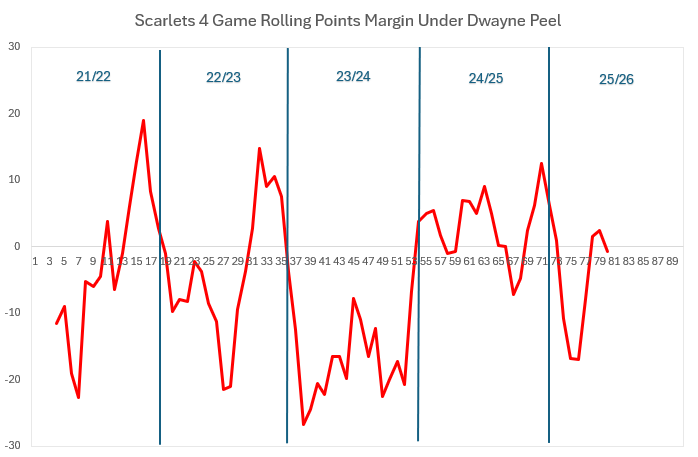
What this shows is that Dwayne Peel is capable of rescuing seemingly disastrous season starts – such as what we are witnessing right now – but he is incapable of maintaining that momentum into the following season. There is every chance the Scarlets could finish this season mid table (8th placed Benetton only have 4 wins from 9) but there would be no confidence of carrying that form into next season.
Short term, the game-plan for this season needs to be redrawn, particularly with regards to the awful attack. Longer term, the Scarlets need to reflect on how they avoid these poor starts that bring unrest to the fanbase and unhappiness to the squad. Not every season can be a rescue job, there needs to be a stable foundation that gets built upon.