Advertisement



Stockdale (5'), Crowley (36'), Conan (43'), Osborne (67')
Tries
Carre (40+1'), Botham (62')
Crowley (6', 44')
Conversions
Edwards (40+2', 62')
Crowley (76')
Penalties
Edwards (16')
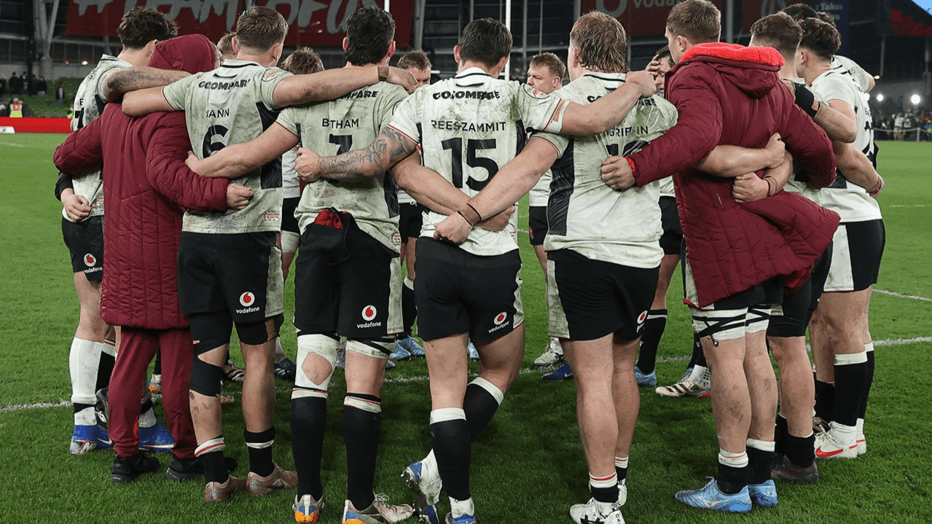
Wales backed up their best performance under Steve Tandy against Scotland with another best performance under Tandy against Ireland. A team who were a guaranteed 50 points just 2 matches ago are becoming gritty, determined and genuinely credible as an international rugby team.
The defence was once again improved, looking far more connected and purposeful as Ireland fire volley after volley throughout the match. Outside centre Eddie James, who had been singled out as a weak point in the first 2 games, was barely troubled and arguably out performed his opposite number Gary Ringrose, who has only just come back from a Lions Tour.
Dewi lake, Alex Mann, Dafydd Jenkins and James Botham were all to the fore as the tackle tally ticked upwards. Lake and Mann in particular have had their doubters this tournament, but both silenced them emphatically as part of a superb team shift that won the plaudits of opposition coach Andy Farrell after the game.
However, it is also fair to question the quality of the attack they were facing. Seeing the tackle count rise above 200 was like something from the Schmidt vs Gatland era 10 years ago. Ireland launched phases after phase of attack from around, and even sometimes beyond, the half way line. Wales had no problem reading and predicting the Irish attack, a point typified by Alex Mann’s stupendous intercept on his own line.
And yet, Ireland still managed to score 4 tries to earn an attacking bonus point. When they did get into Wales’ 22m, they registered 3.3 points per visit, which is above average. It could have been more but for a fumble at the back up a ruck early in the first half. Wales rallied from that point but Tandy should be concerned with how his side continue to start games slowly.
Elsewhere, the lineout was acceptable but not quite as good as it was against Scotland whilst the scrum was a real see-saw battle with both sides getting penalised at times. One of the sights of the match was a furious Tadhg Furlong flinging his opposite man Nicky Smith to the ground after a scrum reset in a fit of rage - he was substituted soon after.
Whilst the defence took a step forward, the attack remains stagnant. Wales have scored most of their recent tries from 5m tap and goes and tried the tactic multiple times in this game but only succeeded once. Rhys Carre’s wonder try was the result of phase attack from distance, but Wales probably cannot rely on him doing that every week.
So, what is it that is holding the attack back? Firstly, the number of 22m entries is still below average; the conversion rate when they get there is ok but there would be less pressure on the entries paying off if they made more of them. A bigger problem, however, is the half-back combination.
After the first match against England, the debate was focused around fly-half Dan Edwards’ relationship with inside centre Ben Thomas. Now, with Thomas out of the team, the conversation has shifted to being about Edwards’ relationship with scrum-half Tomos Williams.
With Jac Morgan injured, Williams is nominally Wales’ best player and thus the attack is mostly controlled by him. However, it is becoming alarming just how many Welsh attacks are passing by with Edwards barely touching the ball.
This was a trend first noted in the game against France and it got worse against Ireland. Between the 25th and 65th minute, the period in which Wales scored both of their tries, Edwards passed the ball 3 times. In the build up to Botham’s try, his only contribution was to kick the first penalty to touch.
From there, he did not feature in the attacks. In fact, for much of them, he wasn’t even in the backline organising play, instead being relegated to cleaning out rucks. At times, it seemed as though centre Joe Hawkins was calling more of the shapes than Edwards.
Some say this is because Matt Sherratt’s game-plan nullifies Edwards’ ball in hand USP, others say Williams clearly doesn’t trust his 10. Either way, Edwards is looking more and more like a square peg in a round hole and it raises questions over the coaches’ selections.
The two men asking those questions the loudest are probably Kieran Hardy and Jarrod Evans, who were both unused substitutes on Friday night. Hardy has been involved in each of Wales’ last 10 games but only seems to get on if Williams is unavailable. He must have been furious as he watched Wales choose to spend 10 minutes playing without a scrum-half, with Edwards doing his best to fill in and Hawkins playing 10.
Evans must also be deeply frustrated. The Wales coaches have simultaneously backed him and not backed him. 12 months ago he thought he was ineligible for Wales thanks to the 25 cap rule, but now he has 8 bench appearances under these coaches. He made sparked a mini-revival against France and was a match winner against Japan, yet the Wales only seem willing to brining him on if they either a) have nothing to lose or b) absolutely have to.
It speaks volumes that Sam Costelow has been retained in the squad despite being carried off the pitch against France; the coaches clearly see him as being vital to their chances of a rare win against Italy next week. Therefore, the question has become why are the coaches not selecting a 10 more similar to Costelow in his absence.
Speaking of the next game, the belief is growing that Wales can end their Six Nations win drought at home to the Azzurri next weekend. The Italians’ result against England will play a major part in their belief going into the game, but Wales need to focus on themselves. They don’t need to be perfect to beat Italy; if they can tick off just 1 or 2 more work-ons they can win. Should that happen, we can call this Six Nations a success.


