


The last pool round fixes who plays whom at Allianz Stadium, and the top of both tables is tight enough that Twickenham, Dublin and Paris could each change the picture. Wales go into Cardiff with the confidence of a result they had waited seventy years to repeat, while Italy and Fiji meet with the bottom places already close to certain.
Round 6 closes the Northern Hemisphere Series, and with it the pool phase of the inaugural Nations Championship. Each side in the North plays the six in the South, and the finished tables then decide the finals weekend at Allianz Stadium. Teams meet the opponent from the other hemisphere who finished in the same position, working from sixth against sixth up to first against first, and that last match decides the champions. Where a side finishes matters even when it has no chance of the title, because it determines the opponent and the occasion that follows.
The top of the North is almost impossible to separate. France lead on 21 points after beating South Africa 21-19 at the Stade de France, with England and Ireland both on 20. England's points difference of plus 134 is far better than Ireland's plus 57, so the two are not equal in practice. In the South, New Zealand lead on 22 and South Africa follow on 21, which means the Saturday meetings with England and Ireland carry real weight for the final pairing. Behind them Scotland and Wales are level on 15 points, Argentina sit on 11, Australia on 9, Japan on 5, Fiji on 0 and Italy on 1. Six Tests on Saturday 21 November will settle most of those orders, starting at Murrayfield and ending in Paris.
Scotland v Japan: turn a narrow win into a finishing flourish




Scotland


Japan
Scotland arrive with the form of a side that has found a way to win a tight game. Their 15-12 victory over Australia last Sunday followed a heavy 43-21 defeat by New Zealand a week earlier, and it was a very different kind of win from the 47-38 shoot-out in Argentina on the opening weekend or the 33-17 victory in Fiji. The challenge now is to show that they can control a match without needing it to be close. With 15 points they are level with Wales in the North table, and Scotland's points difference of minus 8 is the better of the two. Finishing fourth rather than fifth is a small but real prize in a competition that rewards every place.
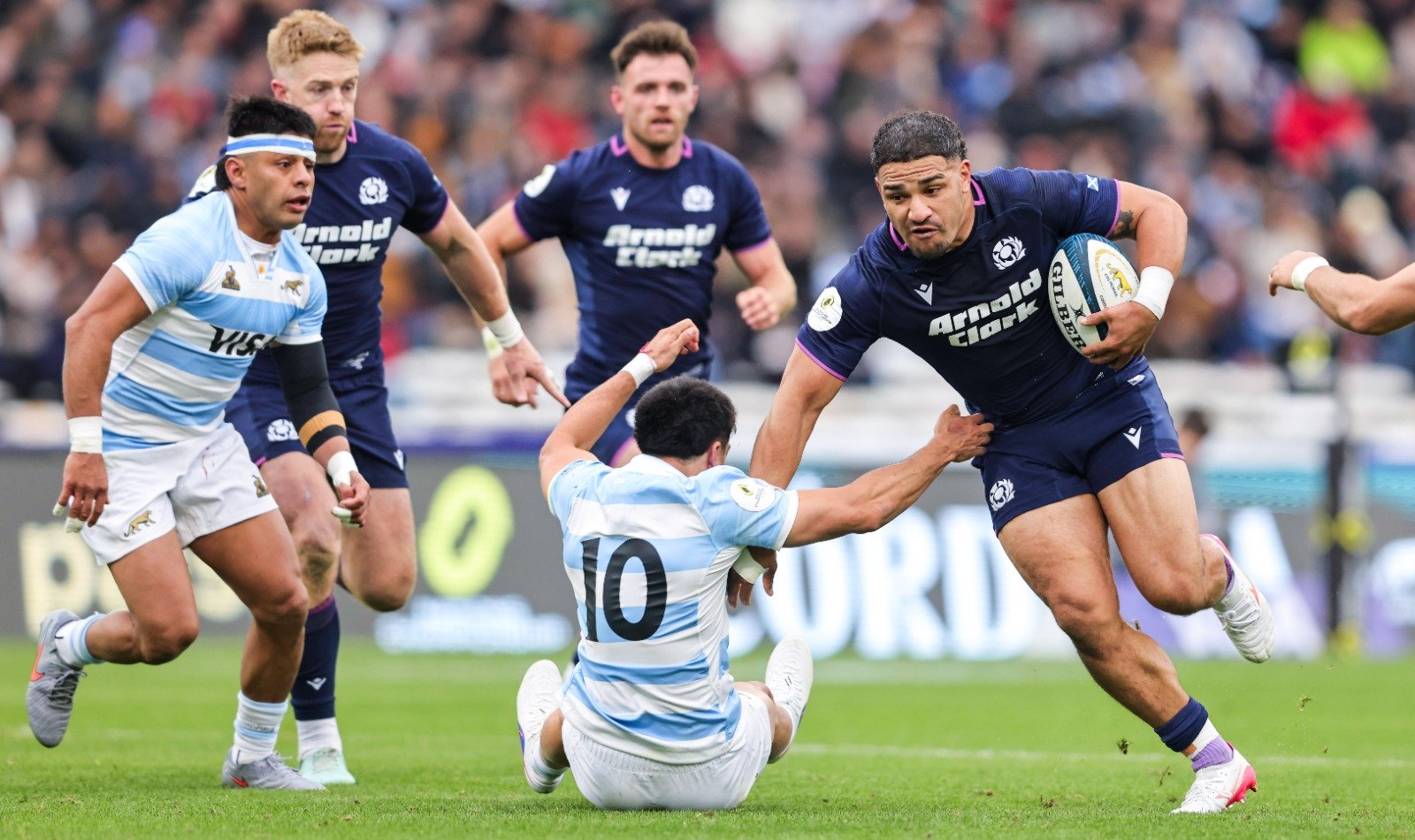
Scotland's ball-carrier, in navy, is tackled by an Argentina player in the light-blue and white hoops during a Nations Championship match. Photo: Scottish Rugby.
Japan come to Edinburgh after a difficult run in the competition. They lost 78-15 at Twickenham, and the 28-21 defeat by Wales a week earlier had at least been a contest. Their only win in the tournament came against Italy in the opening round, and they sit fifth in the South on 5 points. The Brave Blossoms scored tries through Dearns and Helu at Twickenham, which shows they can still create chances, but their defensive structure was stretched beyond what they could repair once England's pace and width took hold. Scotland have the pack and the backline to test that structure in the same way.
The tactical question is how quickly Scotland can force Japan to defend in difficult positions. Japan's best returns have come when the ball is kept alive and the game becomes loose, as it was in their Pacific Nations Cup success over Fiji and the narrow loss to Fiji in October. Scotland should be happy to slow the contest at the breakdown, build pressure through carries and kicks, and make Japan's defenders commit before spreading the ball to the edges. Japan will want quick ruck ball and an attacking shape that keeps Scotland's back row from setting early. The visitors' hopes rest on forcing turnovers and counter-attacking from them, because a long game of set-piece and phase attack would favour the hosts.
The selections have not been confirmed and the teams are due later this week, but the broad picture is clear. Scotland's challenge is to avoid the second-half drifts that have cost them in this tournament, and to treat the match as a chance to convert territorial control into points. A convincing win, ideally with a bonus point, would give them momentum before the finals weekend in London. Japan, by contrast, need a result to bring their campaign back from the margins, and Murrayfield is an unforgiving place to attempt it.
ATR verdict: Scotland by a clear margin. They are the more settled side, have the stronger forward platform and recent results show Japan struggle once a game is played on the opposition's terms.
England v New Zealand: the biggest seeding match of the round


England


New Zealand
This is the match with most riding on it. England sit on 20 points, one behind France, with a points difference of plus 134 that nobody else in the North can approach. New Zealand lead the South on 22, one point ahead of South Africa, which makes the result a fair guide to which side meets whom in the final. England arrive after a run of two heavy wins: 45-22 against Australia and 78-15 against Japan, a game in which Will Joseph scored five tries. New Zealand arrive after the most surprising result of the round, a 35-28 defeat by Wales in Cardiff, Wales' first win over them since 1953.
That defeat is the reason the match is interesting. New Zealand have been strong at Murrayfield, where they won 43-21, and in the October wins over Australia, but in Cardiff the Welsh scored five tries to their four and kept the scoreboard honest. England can expect the All Blacks to be sharper in defence and more precise at the breakdown, and it will be a very different match from the one in which they ran in 78 points. The 33-19 win over New Zealand in November 2025 shows that England can beat them at home when the pack is stable and the kicking game is accurate, but the narrow defeat in 2024 is a reminder of how little separates the sides.
England's team news so far has centred on availability. The squad was cut back to 36 players this week, with Tom Curry, Immanuel Feyi-Waboso and Harry Randall reported out through injury. Jack Kenningham of Harlequins has come into the forwards, and George Furbank, Seb Atkinson and Ollie Chessum have returned to training after missing the Japan game. The matchday 23 has not yet been named, so the shape of the back row and the second row remains an open question, and that is where New Zealand's breakdown work will be tested hardest.
The match is likely to be decided by whether England can keep the contest in the forwards and in the air. New Zealand's attack is at its best when the ball moves quickly through a disorganised defence, so England's task is to slow the ruck, keep their line speed honest and make the visitors work from set-piece rather than from turnovers. If the game becomes loose, as it did in Cardiff, New Zealand's finishers are more dangerous. England's recent scores show how much they gain when the early exchanges go their way, but the All Blacks have the experience to respond to a fast start.
The result has a bearing beyond Saturday. A home win would strengthen England's claim to a high place in the North and put New Zealand's top position under pressure from South Africa. An All Blacks win would restore their standing after Cardiff and probably send them to the finals weekend as top seeds.
ATR verdict: England by a narrow margin. Home advantage, the form of their pack and the Cardiff defeat suggest New Zealand will be well motivated, but England have the more reliable platform in this meeting.
Italy v Fiji: a first win is the only prize that matters


Italy


Fiji
Neither side has much room left in the table. Italy have 1 point from five matches and Fiji have none, and each is close to certain to finish sixth in its hemisphere. That makes this a meeting of two teams who will probably meet again in London in the sixth-against-sixth match. In that sense the Udine match is a first leg, and the side that finds a way to win it will take real confidence into the finals weekend.
Italy have the closer margin to point to. Their 14-19 defeat by Argentina in Genoa was the nearest they have come to a win in this competition, with tries from Ioane and a penalty try, and it followed the 66-7 defeat by South Africa in Turin. They were beaten 27-10 in Japan in the opening round and heavily by New Zealand and Australia in July. Gonzalo Quesada has had to work around a long injury list this autumn, with several first-choice players missing, which is one reason the results have been so variable.
Fiji's season has been harder than the individual matches suggest. They lost 43-15 in Dublin last Saturday and 54-17 to France the week before, but they started the competition with a 39-24 defeat by Wales and a 73-8 defeat by England in July, and in October they beat Japan 34-28. The attacking talent has not gone away. What has been missing is a defence that holds across 80 minutes and a set-piece that supplies a platform. Italy's recent matches suggest they can make Fiji pay for loose kicking and indiscipline, since their forwards have been competitive and their goal-kicker has kept the scoreboard moving.
The match will probably be decided by territory and by which side finds the more reliable route to the opposition 22. Italy should aim to keep the game narrow, compete on the gain line and use their kicking to keep Fiji's back three from counter-attacking in space. Fiji need quick ball and an attack that moves wide before Italy's defenders are set. If Italy hold their shape for the first quarter they have enough to win, and the selection, which has not yet been announced, will show how much Quesada wants to build for the finals weekend.
ATR verdict: Italy by a few points. Home advantage and the closeness of the Argentina game give them the edge, but Fiji's attacking ability makes this a match that could turn on one loose kick.
Ireland v South Africa: a rematch that now shapes the final


Ireland


South Africa
Ireland and South Africa are the two sides most likely to decide whether the North and South tables finish as expected. Ireland are on 20 points with four wins from five, and their home form has been strong, with a 42-12 win over Argentina followed by 43-15 against Fiji. South Africa are on 21 after losing 21-19 in Paris, a match that took away the unbeaten record they had carried through the July matches. The result matters for placings in both tables, since a South African win would put them level with or ahead of New Zealand, and an Irish win could close the gap to France.
The last meeting in Dublin, in November 2025, went to South Africa 24-13, and the two sides were also split in 2024, when Ireland won 25-24 in Durban after losing the first Test 27-20. The pattern is of close matches decided by the set piece and the kicking game. South Africa were beaten in Paris largely because France scored three tries and kept their discipline, and Ireland will take note of how France managed the contest, as the Springboks' bench has the power to change a match in the last 20 minutes.
South Africa's route to this match has been uneven by their standards. They beat Scotland 42-28 in Round 2 and Wales 43-0 in July, then scored 66 against Italy in Turin, and the defeat in Paris came with tries from Wessels, Reinach and Marx. The scoring suggests an attack that is productive when it gets quick ball from the set piece. Ireland's defence has to deal with that, and the work at the breakdown will be the key to whether they can slow the supply of ball. In July they lost 40-21 to New Zealand, which shows the cost of being second best in the contact area.
Ireland's task is to keep the match on their terms. They have the half-backs to control territory and the lineout to build pressure, and their recent home wins show how clinical they can be when the platform is stable. If South Africa's pack gets on top, the visitors' kicking and chasing can make it a long afternoon for the Irish back three. The teams have not yet been named and the injury picture should be clearer later this week, so the selection at ten, in the centre and in the back row will be worth watching.
Ireland have the home crowd and the greater need, while South Africa have the greater physical edge. A narrow margin is the most likely outcome, and it may come down to who handles the bench better.
ATR verdict: Ireland by a score. The Aviva crowd and their form at home give them a small edge in a match that will probably be settled by the last ten minutes.
Wales v Australia: keep the Cardiff momentum going


Wales


Australia
Wales come to this match with a result that changes how the autumn is remembered. Their 35-28 win over New Zealand last Saturday ended a run of 34 defeats against the All Blacks, with five tries scored and James Botham named player of the match. It followed a 28-21 win over Japan, and with 15 points Wales are level with Scotland in fourth and fifth place. The question for Steve Tandy's team is whether they can repeat the performance when the opposition are less likely to be surprised.
Australia arrive in a different state of mind. Their 15-12 defeat in Edinburgh followed a 45-22 loss to England, and with 9 points they sit fourth in the South, behind Argentina on 11. They have won one match in five in the competition, and the 21-43 loss to New Zealand in October showed how quickly their defence can be pulled apart. The Wallabies did beat Wales 52-20 in Cardiff in 2024, but Wales' 40-6 win at the 2023 World Cup is a reminder that results between the sides swing sharply.
The match may come down to ball retention. Wales scored five tries against New Zealand because they kept possession long enough to put the opposition under pressure, and Australia's three losses in the Northern Series have come when they conceded early scores and chased the game. If Wales are accurate at the breakdown and make good use of the first half, the crowd will carry them. Australia's best route is a quick tempo and a physical start, with their back line given room to run.
The selections have not yet been confirmed, but the bench is likely to matter given the intensity of the contest in Cardiff. Wales also need to guard against the emotional hangover from a famous win, since a flat start would give Australia the chance to make the match a scrap. For Australia, a win would lift them above Argentina's tally if results elsewhere allow, while for Wales it would send a clear message about their progress under Tandy.
ATR verdict: Wales by a narrow margin. Their form and the Cardiff crowd count for more than Australia's reputation, but the visitors have the talent to take the game if Wales start slowly.
France v Argentina: protect the top seed without a settled ten


France


Argentina
France lead the North on 21 points and finish the pool phase at home, where they beat South Africa 21-19 last Friday with tries from Grandidier-Nkanang, Attissogbe and Bielle-Biarrey, and Antoine Dupont was named player of the match. Having beaten Fiji 54-17 in Round 4, they have the points but not the margin: England's points difference is far better, and a slip against Argentina would let England or Ireland pass them. The match is therefore about protecting top place and the right to meet the South's leaders in the final.
The selection issue is at fly-half. Romain Ntamack, Thomas Ramos and Hugo Hastoy are all injured, which meant Galthié used a Maxime Lucu and Dupont combination at half-back against South Africa. The 42-player group for this match has Matthieu Jalibert returning, along with Anthony Jelonch, Joshua Brennan, Alexandre Fischer, Hugo Avogadro and Nicolas Depoortere, while six others have been released. Avogadro is one of six uncapped players in the group, with Antoine Deliance, Grégoire Arfeuil, Axel Desperes, Mathis Ferté and Tani Vili. The team will be named on Thursday 19 November, so how Galthié balances Jalibert's attacking game against the control of Dupont and Lucu is still to be settled.
Argentina come in with a 19-14 win over Italy, built on tries from Bernasconi, Isgro and Carreras, and with 11 points they are third in the South. They lost 42-12 in Dublin in Round 4, and the pattern of their autumn has been a strong pack and a side that can score but sometimes leaves points behind. France beat them 37-23 at the same ground in November 2024, although Argentina won 33-25 in Mendoza earlier that year. Felipe Contepomi's team will take heart from that record, as they often play with more freedom when the pressure is on the opposition.
The match will probably turn on the scrum and the kicking battle. If France can use their set-piece to gain territory and deny Argentina easy exits, their backs will have chances to counter. If Argentina's forwards win the physical exchanges, they can slow the game and force France into errors. France's back line has more attacking depth, but a game that becomes a contest of pressure favours the side that has already shown it can win in that way.
For France the target is simple: win, keep the top place and carry momentum into the final. For Argentina it is a chance to finish a hard season with a performance, and perhaps to move further clear of Australia.
ATR verdict: France by eight to twelve points. The Stade de France and a stronger attack should see them through, although uncertainty at fly-half keeps Argentina in the contest for longer than the table suggests.
Standings
| # | Team | PL | W | L | D | PD | BP | PTS | Form |
|---|---|---|---|---|---|---|---|---|---|
| 1 |  France | 5 | 4 | 1 | 0 | 80 | 5 | 21 | W W W W L |
| 2 |  England | 5 | 4 | 1 | 0 | 134 | 4 | 20 | W W W W L |
| 3 |  Ireland | 5 | 4 | 1 | 0 | 57 | 4 | 20 | W W L W W |
| 4 |  Scotland | 5 | 3 | 2 | 0 | -8 | 3 | 15 | W L W L W |
| 5 |  Wales | 5 | 3 | 2 | 0 | -28 | 3 | 15 | W W L L W |
| 6 |  Italy | 5 | 0 | 5 | 0 | -158 | 1 | 01 | L L L L L |
| # | Team | PL | W | L | D | PD | BP | PTS | Form |
|---|---|---|---|---|---|---|---|---|---|
| 1 |  New Zealand | 5 | 4 | 1 | 0 | 66 | 6 | 22 | L W W W W |
| 2 |  South Africa | 5 | 4 | 1 | 0 | 138 | 5 | 21 | L W W W W |
| 3 |  Argentina | 5 | 2 | 3 | 0 | -27 | 3 | 11 | W L L W L |
| 4 |  Australia | 5 | 1 | 4 | 0 | 3 | 5 | 09 | L L W L L |
| 5 |  Japan | 5 | 1 | 4 | 0 | -96 | 1 | 05 | L L L L W |
| 6 |  Fiji | 5 | 0 | 5 | 0 | -161 | 0 | 00 | L L L L L |
A weekend that sets the finals picture
By Saturday night most of the structure of the finals weekend will be known. France, England and Ireland are separated by a point at the top of the North, and New Zealand and South Africa by the same margin in the South, so the three biggest matches of the round carry consequences for who plays whom at Allianz Stadium. The match at Twickenham is the most intriguing, because England need to show that their recent scoring can be repeated against a side that has just been reminded of its own fallibility.
Further down, the sides in the middle have different incentives. Scotland and Wales are separated only by points difference, Australia are chasing Argentina for third, and Italy and Fiji meet with a view to the sixth-against-sixth match that follows. None of that carries the weight of the title, but the table positions are the competition's way of rewarding the whole campaign, and Round 6 will decide how well each team has done it.