

France will meet South Africa at Twickenham on 29 November after a night in which England won handsomely and still finished second. Ireland, Australia and Fiji all took something from the round, and Scotland ended it with 67 points.
The final round of the pool phase had been billed as a straight race, and it settled quickly where it mattered. France arrived at the Stade de France level on points with their rivals in the North and left it with a 45-17 win that took them to 26 points, one clear of England on 25 and two clear of Ireland on 24. England's 37-12 victory over New Zealand was as convincing as any result of the weekend, but it could only matter if France stumbled, and they did not. The top of the North therefore finished on margins of a single point and then a single point again, in a table that rewarded France for the bonus points they gathered along the way.
The South was tighter still. South Africa and New Zealand finished level on 22 points, and it was a losing bonus point in Dublin that kept the Springboks in front, with points difference then separating the two sides in their favour. Beyond the Grand Final line, the weekend carried a different kind of meaning: Australia ended a run of four straight defeats in Cardiff, Fiji claimed their first win of the competition in Udine, and Scotland closed their pool campaign with a 67-5 win at Murrayfield. Those results shape the rest of the Finals Weekend in London, where every side plays a position-for-position fixture against its opposite number from the other hemisphere.
Scotland turn the first half into the match




Scotland



Japan
D. Graham (5', 30', 78'), L. McConnell (12', 47', 56'), K. Rowe (19'), O. Smith (39', 66'), J. Dobie (61'), R. Hutchinson (73')
Tries
T. Matsunaga (52')
T. Jordan (13', 31', 56'), G. Horne (62', 67', 79')
Conversions
Scotland's 67-5 win over Japan was settled in the opening forty minutes, when they scored five tries and led 29-0 at the interval. Darcy Graham, Liam McConnell, Kyle Rowe and Ollie Smith all crossed before the break, with Graham and McConnell setting the tone by scoring inside the first quarter. Japan, who had given Wales a hard afternoon a fortnight earlier, were never in a position to build pressure on a side that took its chances so cleanly.
The second half was more of the same, and the numbers say a good deal about how the day went. Scotland added a further 38 points, with McConnell completing his first Test hat-trick on 56 minutes and Graham finishing his own with the final try on 79. Jamie Dobie and Rory Hutchinson also scored, and Tom Jordan and George Horne shared the goal-kicking, with six conversions between them. That Japan's single reply, from Takuro Matsunaga on 53 minutes, came during a spell when Scotland were already 24 points clear shows how little the visitors had to hold on to.
The result matters less for what it says about Japan than for what it does for Scotland's shape of season. After a defeat by New Zealand and then a narrow 15-12 win over Australia, a scoreline of this size gives the squad a convincing way to end the pool phase and shows that the attack can be productive without a close game forcing it. Scotland finish fourth in the North on 20 points, behind Ireland, and Japan end up fifth in the South on five points, with a single win from six.
For Japan the lesson is a familiar one from this competition: they were able to compete for periods against Wales and for Fiji's scalp in the autumn, but a side that concedes five tries in a half is rarely able to recover. Their Finals Weekend match is a chance to put a more even eighty minutes together.
England win the match and lose the table by a point


England


New Zealand
H. Slade (4'), van Poortvliet (31'), B. Earl (35'), O. Chessum (42'), S. Atkinson (62')
Tries
de Groot (38'), B. Barrett (51')
F. Smith (31', 36'), M. Smith (63')
Conversions
D. McKenzie (51')
M. Smith (56', 80')
Penalties
England beat New Zealand 37-12 and will still not play in the final. They finished on 25 points, one behind France, and no amount of control against the All Blacks could change that. It leaves a performance of real quality with a slightly hollow edge: England did what they could on the day and had to wait for France to do the rest.
The match was effectively won in the opening half. Henry Slade scored after five minutes, Jack van Poortvliet and Ben Earl added tries on 32 and 36, and England turned round 19-5 ahead after Ethan de Groot had replied for New Zealand just before the break. Ollie Chessum's try on 43 minutes stretched the lead to 24-5, and from there England had the scoreboard on their side and could manage the contest rather than chase it.
New Zealand's response was a try for Beauden Barrett on 52 minutes, converted by Damian McKenzie, which briefly cut the gap to 24-12. It was the last score they managed. Marcus Smith kicked a penalty on 57, Seb Atkinson scored England's fifth try on 63, and a late Marcus Smith penalty completed the scoring. Holding the All Blacks to two tries and nothing at all in the last half hour is the part of the afternoon that England can take into whatever comes next.
The consequences are mixed for both sides. England go to Finals Weekend as the second-placed side in the North, which on the format sets up a meeting with the second-placed side in the South, and they will want to show that their margin over New Zealand was not a one-off. New Zealand, who lost to Wales a week earlier, finish second in the South on 22 points, level with South Africa but behind them on points difference, and they have been left with the uncomfortable sense that a competition they led at times has slipped away in the last fortnight.
Fiji find a first win, Italy stay empty-handed


Italy


Fiji
L. Cannone (8')
Tries
T. Ikanivere (17', 44'), K. Salawa (51')
T. Allan (9')
Conversions
B. Volavola (18'), C. Muntz (45', 51')
T. Allan (13', 32', 64')
Penalties
Fiji's 21-16 win in Udine was their first in the competition and left Italy as the only side to finish the pool phase without a victory. It came from three tries to one: Tevita Ikanivere scored twice and Kitione Salawa added the third, with Ben Volavola and Caleb Muntz sharing the conversions. For a team that had lost five games in a row, including heavy defeats to France and Ireland, it was a result that mattered for confidence as much as for the table.
Italy's afternoon had a clear pattern. Tommaso Allan kicked three penalties and converted Lorenzo Cannone's try, which kept the hosts in touch throughout, but the return from their territory and possession was one try to Fiji's three. A side that finishes with 16 points and only a single try has usually asked too much of its kicker, and that is the central frustration of a pool in which Italy have not found the attacking edge that would turn pressure into tries.
The margin of five points is also a reminder of how narrow Italy's results can be when the defence is organised. It is the sort of loss that is harder to take than the 66-7 defeat by South Africa a fortnight ago, because the match was there to be won. Fiji, meanwhile, finish on four points, bottom of the South but with a victory to point to, and Italy end on two points with six defeats.
The two sides are due to meet again on Finals Weekend in London, as the bottom-placed teams from each half. Italy will want that rematch to be a chance to correct what went wrong in Udine, and Fiji to show that this result was not an accident.
Ireland win, South Africa take the point that matters


Ireland


South Africa
R. Baloucoune (7', 18'), R. Kelleher (39')
Tries
van den Berg (35'), M. Marx (57')
S. Prendergast (40')
Conversions
S. Feinberg-Mngomezulu (36', 58')
S. Prendergast (53')
Penalties
S. Feinberg-Mngomezulu (4')
Ireland beat South Africa 20-17 at the Aviva Stadium, and the Springboks still came away with the outcome they needed. A losing bonus point, earned by finishing within seven points, took South Africa to 22 points, level with New Zealand, and the superior points difference put them top of the South and into the final against France. For Ireland the win was a real result in its own right, though it left them third in the North on 24 points and outside the final.
Robert Baloucoune made the first-half running with two tries inside the opening 18 minutes, and Rónán Kelleher's try on 40 minutes, converted by Sam Prendergast, took Ireland to the interval with a 17-10 lead. South Africa had a penalty from Sacha Feinberg-Mngomezulu on five minutes and a try from Morne van den Berg on 35, but Ireland controlled the territory and scored in the right places, which was the difference over the first forty minutes.
The second half was a narrower, tenser contest. Prendergast's penalty on 53 minutes made it 20-10, and Malcolm Marx's try four minutes later, converted by Feinberg-Mngomezulu, cut the lead to three. Neither side scored again, and Ireland's ability to hold the lead for the last twenty minutes, in a game that also saw a yellow card for each side by the 72nd minute, is what a lot of supporters will take from the afternoon.
The broader picture is a useful one for Ireland. A string of heavy defeats against the leading southern sides had hung over the season, and beating a South Africa team of this calibre, even one that was playing for a point rather than a win, is the sort of result that restores some belief. The Springboks go to London knowing that they lost a Test that they managed to turn to their advantage, and that France, who beat them by two points a week earlier, will be waiting.
Australia end the losing run by three points


Wales


Australia
D. Lake (40', 49'), B. Murray (54'), R. Elias (78')
Tries
T. Tupou (20'), B. Paenga-Amosa (32'), M. Jorgensen (46'), L. Ikitau (63')
S. Costelow (40+1', 50', 55')
Conversions
R. Lonergan (33', 47'), C. Gordon (64')
Penalties
C. Gordon (73')
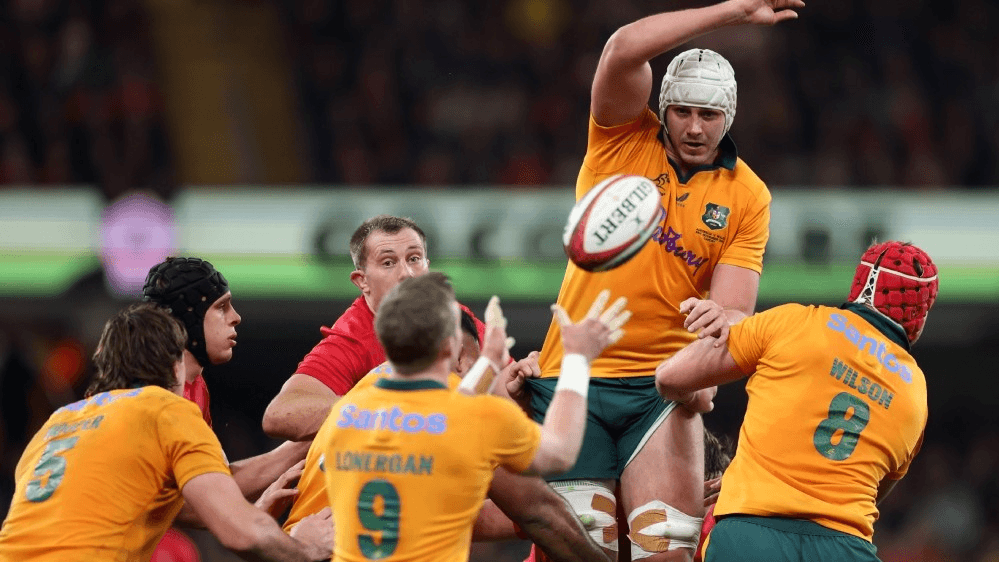
Australia beat Wales 29-26 in Cardiff to end a run of four consecutive defeats, and they did it despite finishing the match a player short. It was a result that settled in the final few minutes: Carter Gordon's penalty on 73 minutes put the Wallabies 29-21 clear, and a late Wales try only reduced the gap to three points.
Wales had cause to feel they might have taken more from the game. They scored four tries through Dewi Lake (two), Blair Murray and Ryan Elias, with Sam Costelow converting three of them, and they started the match with fourteen players after Max Llewellyn was sent to the sin-bin in the second minute. That is a heavy early burden to carry and Wales still scored consistently, which is a point in their favour, but Australia's four tries, from Taniela Tupou, Brandon Paenga-Amosa, Max Jorgensen and Len Ikitau, gave them enough of a cushion to survive the closing exchanges.
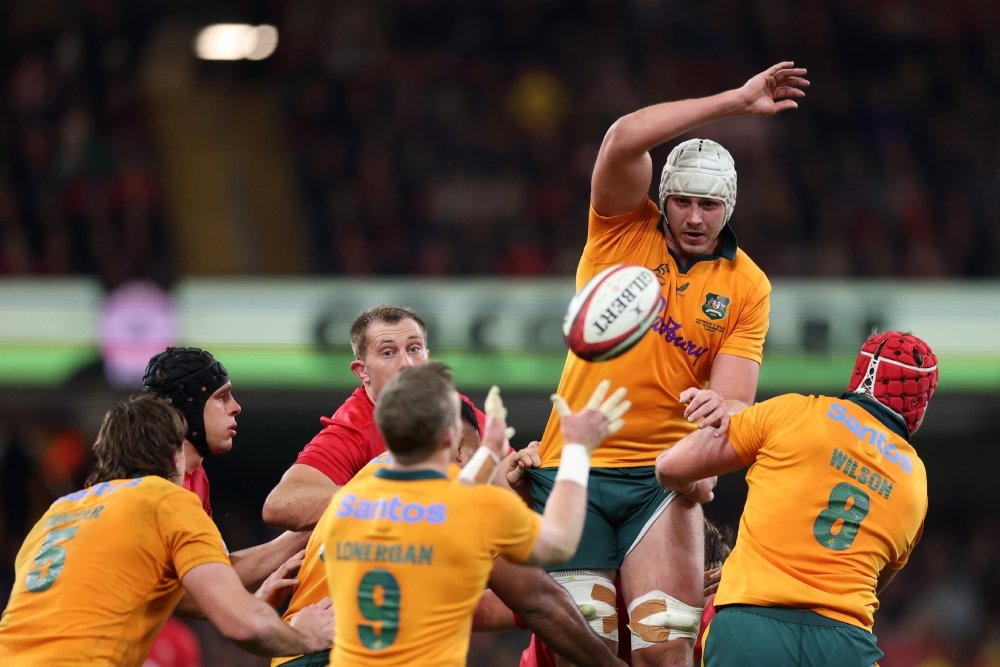
Australia contest a lineout against Wales in Cardiff during their Nations Championship match on 21 November 2026. Photo: Rugby Australia.
The pivotal passage came after the hour. Ikitau scored on 64 minutes, with the conversion following, and Gordon's penalty extended the margin to eight. Elias's try on 79 minutes came when Wales needed it most, but the conversion was missed, which left them three behind and without a kickable route to a draw in the time that remained. Australia had Harry Wilson in the sin-bin for the last minutes, and that they held on while a man down says something about the resolve of a team that had not won for a month.
In the table the effect is modest but real. Australia finish third in the South on 14 points, ahead of Argentina, and Wales finish fifth in the North on 17, with two defeats from their last three at home. Wales' fixture on Finals Weekend, if the format holds, is against Japan, a match that offers the chance to end the competition with something to show for the effort they put in at the Principality.
France turn a disciplined night into a final


France


Argentina
M. Guillard (6'), P. Mauvaka (33'), K. Gourgues (46', 69'), E. Gailleton (63'), T. Duguid (67'), L. Bielle-Biarrey (77')
Tries
J. Piccardo (16'), P. Matera (71')
K. Gourgues (7', 34', 47', 68', 78')
Conversions
T. Albornoz (17', 72')
Penalties
T. Albornoz (23')
France beat Argentina 45-17 at the Stade de France and, with that, secured the first place in the North that carries them into the Nations Championship final against South Africa. Seven tries gave them the bonus point and the extra margin that proved decisive, because England's win at Twickenham would have taken the top spot had France slipped. A one-point gap in the final table made every score in Paris count.
The try-scorers were spread across the side: Mickaël Guillard, Peato Mauvaka, Émilien Gailleton, Tyler Duguid and Louis Bielle-Biarrey crossed alongside two from Kalvin Gourgues, who also kicked five conversions. That is a full evening's work from one player, and it fits a French attack in which the scoring is shared between forwards and backs rather than resting on a single source. Argentina's replies came from Justo Piccardo and Pablo Matera, with Tomás Albornoz adding a penalty and two conversions.
Discipline shaped the closing stages. Mayco Vivas was shown a red card for head contact on the hour, which under the twenty-minute card allowed Argentina to replace him but left them short for a long period, and Julián Montoya was yellow-carded a few minutes later. A side that has to play through that sort of spell is rarely able to protect its defence, and France's scoring in the last quarter of the game, at least three of their tries in the closing twenty minutes, reflected it.
For Argentina the defeat ends a campaign in which they won two of six, and they finish fourth in the South on 11 points. For France, it is a first final in this competition and a rematch with a South Africa side they beat 21-19 a week earlier, a game that left its own mark on the Springbok camp. The two sides meet at Twickenham on Sunday 29 November, and on the evidence of the last fortnight there is very little between them.
Updated standings
| # | Team | PL | W | L | D | PD | BP | PTS | Form |
|---|---|---|---|---|---|---|---|---|---|
| 1 |  France | 6 | 5 | 1 | 0 | 108 | 6 | 26 | W W W W W |
| 2 |  England | 6 | 5 | 1 | 0 | 159 | 5 | 25 | W W W W W |
| 3 |  Ireland | 6 | 5 | 1 | 0 | 60 | 4 | 24 | W W W L W |
| 4 |  Scotland | 6 | 4 | 2 | 0 | 54 | 4 | 20 | W W L W L |
| 5 |  Wales | 6 | 3 | 3 | 0 | -31 | 5 | 17 | L W W L L |
| 6 |  Italy | 6 | 0 | 6 | 0 | -163 | 2 | 02 | L L L L L |
| # | Team | PL | W | L | D | PD | BP | PTS | Form |
|---|---|---|---|---|---|---|---|---|---|
| 1 |  South Africa | 6 | 4 | 2 | 0 | 135 | 6 | 22 | L L W W W |
| 2 |  New Zealand | 6 | 4 | 2 | 0 | 41 | 6 | 22 | L L W W W |
| 3 |  Australia | 6 | 2 | 4 | 0 | 6 | 6 | 14 | W L L W L |
| 4 |  Argentina | 6 | 2 | 4 | 0 | -55 | 3 | 11 | L W L L W |
| 5 |  Japan | 6 | 1 | 5 | 0 | -158 | 1 | 05 | L L L L L |
| 6 |  Fiji | 6 | 1 | 5 | 0 | -156 | 0 | 04 | W L L L L |
A final built on small margins
The pool phase ended the way a competition of this design tends to, with a handful of points deciding who plays on the final Sunday. France finished a point clear of England and South Africa were separated from New Zealand only on points difference, so the Grand Final line-up owes as much to a bonus point in Dublin and a seventh try in Paris as it does to any single dominant performance. That is a reason to think the final will be tight: these are two sides that met a week ago and were separated by two points.
Elsewhere the round answered smaller questions that will matter on Finals Weekend. Scotland scored 67 and Australia found a win when they needed one, Ireland rediscovered some belief in a defeat of the Springboks, and Fiji won for the first time. England, meanwhile, can reflect that a 37-12 win over New Zealand is the performance of a side that belongs in the final, and that the format left them one point short.